Know Your Business Value:
Key Drivers, Scenarios, and Actionable Insights
Planning focused valuation which identifies the drivers influencing value and applies them to real decisions through scenario modeling.
Book a Valuation Strategy Call

Value Driver Analysis:
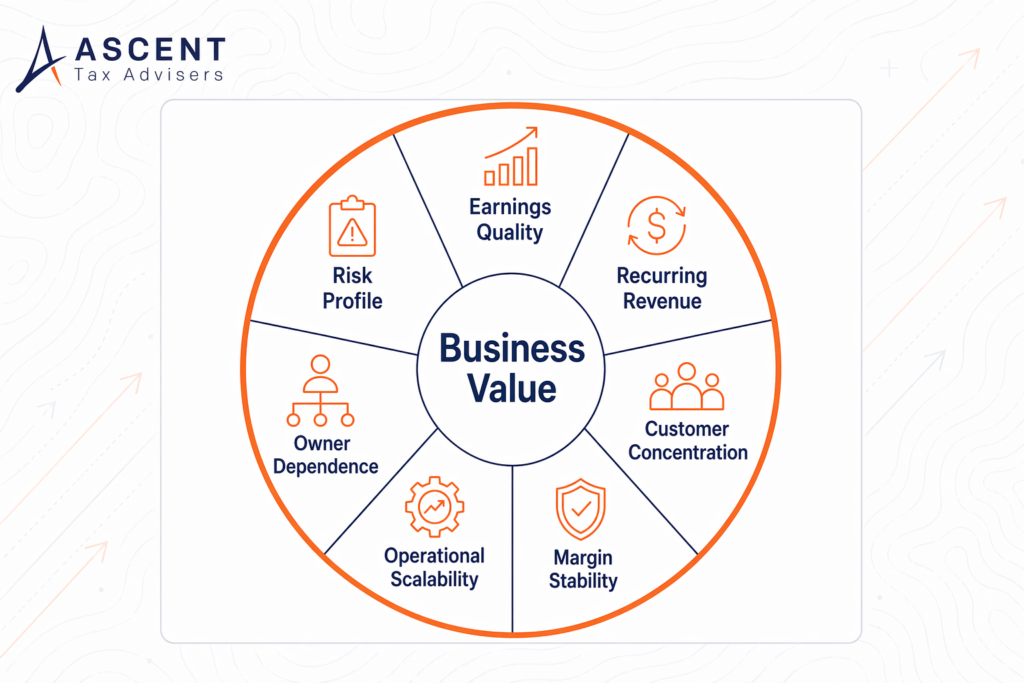
What Impacts Your Business Value Most
A strategic valuation starts with understanding what drives value. Value driver analysis helps clarify which financial and operational factors most influence business value, creating a more informed foundation for planning discussions and scenario evaluation.
Book a Valuation Strategy Call
Scenario Modeling:
Test Strategic Decisions Before You Commit
Value drivers tell you what influences business value. Scenario modeling helps you apply that insight to real decisions by evaluating the likely trade offs of different paths. We use scenario analysis to compare options like pricing changes, hiring key roles, expanding capacity, or adjusting your service mix so you can see how those moves may affect cash flow, risk, and overall business value before you invest time and capital
Book a Valuation Strategy Call
What You Get From a Strategic Valuation
You receive a documented valuation summary plus a planning focused view of the drivers influencing value today. The deliverables are designed to support real decisions by clarifying assumptions, highlighting key sensitivities, and organizing insights into a format you can use in planning discussions.
- Valuation summary with clear assumptions and methods
- Value driver findings and key sensitivities
- Scenario comparisons with planning implications
How the Process Works
We start by understanding your planning goals and reviewing key financial and operational inputs. From there, we identify the drivers that most influence value, model scenarios tied to your decisions, and translate findings into practical planning insights you can act on.
- Discovery and data review
- Value driver analysis
- Scenario modeling
- Insights discussion and next step planning
Who a Strategic Valuation Is For
This approach is designed for owners making decisions that affect long-term value, such as pricing changes, adding leadership, investing in growth capacity, or reducing dependency risks. If you want more than a static number and need decision support, this is the right fit.
- Growing teams and capacity
- Changing pricing or service mix
- Planning major investments
- Reducing owner dependence or concentration risk
Ready to pressure test your strategy with a valuation framework?
Book a strategy valuation call to discuss scope, inputs, and what you would receive.
Strategic Valuation FAQs
What information do you need to start?
We typically begin with:
- Recent financial statements (3 to 5 years)
- Current year performance
- Business overview (industry, structure, services, customers)
- Business plans (expansion, sale, or ownership transition)
How is a strategic valuation different from a standard valuation report?
A standard valuation report is typically:
- A one time, point in time estimate
- Focused on compliance, tax, or legal requirements
- Static once completed
A strategic valuation is different:
- It evaluates what drives your business value
- It models how value changes under different scenarios
- It supports planning decisions, not just reporting
- It can be updated and refined over time
The focus is not just "what your business is worth today," but "what it could be and how to improve it."
Can this support planning even if I’m not selling?
Yes. In most cases, clients engage before any sale is imminent.
This work supports:
- Long term exit planning
- Growth and reinvestment decisions
- Compensation and distribution strategies
- Partner or ownership changes
- Understanding how current decisions impact future value
Even if a sale is years away, understanding value drivers early creates more flexibility and better outcomes.
What does the deliverable include?
The deliverable is designed for clarity and decision making rather than just documentation.
It typically includes:
- A valuation range, not just a single number
- Explanation of assumptions and methodologies
- Key value drivers and risk factors
- Scenario based analysis (growth, margin, timing)
- Recommendations to improve value
In addition, we walk through the results with you to ensure the insights are clear and actionable.
What happens after the valuation?
The valuation is often the starting point, not the end of the process.
After the initial analysis, we may:
- Refine assumptions as new information becomes available
- Update the valuation as conditions change
- Identify and track value improvement initiatives
- Integrate findings into tax, planning, or exit strategy work
Some clients use this as a one time engagement. Others continue as part of ongoing advisory.
How long does the process typically take?
That depends on the size of your business and your objective(s).
If you need a valuation for legal, tax, or compliance purposes, a formal report may be required.
If your goal is planning, decision making, or understanding value drivers, a strategic valuation is often more useful because it is more flexible, interactive, and focused on outcomes.
We can help determine the appropriate approach based on your situation.
How is value actually determined?
Business value is typically driven by three core areas:
- Future cash flow assumptions
- The risk associated with generating that cash flow
- Market based valuation benchmarks
Rather than relying on rules of thumb, we evaluate how these factors apply to your specific business and how changes in each area impact overall value.
Book a Valuation Strategy Call